



 Getty Images
When undergraduate Miles Kwan launched a petition demanding answers from Hong Kong authorities after one of the city’s deadliest fires last week, he was arrested for sedition.
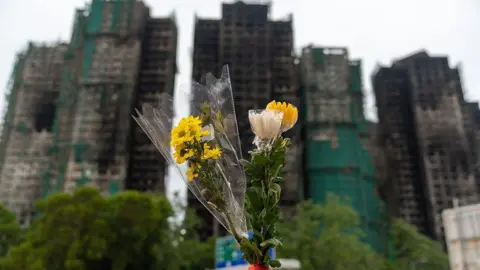
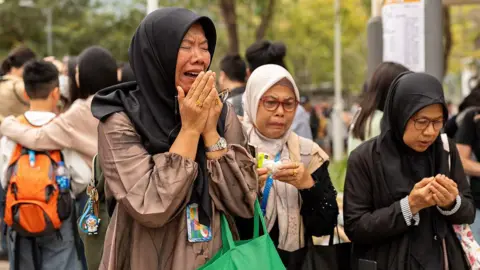
The ferocious blaze had ravaged a densely populated housing estate in the northern Tai Po district, killing at least 159 people and displacing thousands – leaving the city with its biggest challenge since 2019, when widespread protests broke out after China tried to tighten control over the territory.
Worried that public anger will once again explode into massive protests, the pro-Beijing authorities had warned, repeatedly, against attempts to “exploit” the fire to “endanger national security”.
Kwan would end up being just one of several people detained under Hong Kong’s controversial national security law, after they called for accountability from the government.
To some, the decision was “baffling”. To others, it was simply Beijing’s playbook, replicated.
‘A human response to tragedy’
Hong Kong was once admired for its spirited civic activism, but the government’s reaction to the Tai Po fire reflects a city that has become, more than ever before, a part of mainland China – where criticism of the government is not tolerated.
However, Ronny Tong, a member of Hong Kong’s Executive Council, disputed the suggestion that Hong Kongers are being suppressed. “The government is trying to be prudent,” he tells the BBC.
Regina Ip, another Hong Kong lawmaker, defended the arrests using similar language. Authorities are being “extra careful” that public anger does not led to a “recurrence of the 2019 riots”, she told the BBC’s Newshour radio programme.
“You have to differentiate genuine expressions of opinion from petitions with criminal intent. That is what our courts will have to find out.”
But critics say Beijing’s sweeping national security law, introduced in response to the 2019 protests, has severely quelled dissent, but authorities argue it is necessary to maintain stability.
Kwan’s petition, which listed “four demands” – echoing the “five demands, not one less” slogan that rallied protesters in 2019 – gathered more than 10,000 signatures in less than a day before it was taken down.
Days later, the city’s leader John Lee said Hong Kong would “go all out” to support victims and investigate the blaze, pledging actions that sounded similar to Kwan’s petition.
These include convening an independent inquiry into the fire, a review of the building works system, and offering temporary accommodation and financial aid to victims.
In the past week, authorities have also arrested 15 people on suspicion of manslaughter and ordered the removal of mesh netting from all buildings undergoing renovations after investigators found that the one wrapped around the charred complex did not meet flame retardant standards.
“It’s baffling how Miles was [arrested] for asking basic questions on behalf of many residents, which the government went on to address anyway,” said Samuel Chu, a pro-democracy activist who reposted Kwan’s petition on a separate platform.
“This is not a political campaign. It’s a human response to the tragedy,” he said.
 Getty Images
China’s national security office in Hong Kong swung into action swiftly after last week’s disaster, warning that it would take action against anyone trying to instigate “black terror” – a phrase Beijing had used to describe the 2019 protests.
In a more strongly-worded statement this week, it vowed to punish “hostile foreign forces… no matter how far away” they may be.
Lee, Hong Kong’s chief executive, said he will “ensure justice is [served]” to anyone who tries to “sabotage” relief efforts.
Former district councillor Kenneth Cheung, who is among those arrested under the national security law, says authorities took issue with content he re-shared on Facebook following the fire.
“The Tai Po fire is a tragedy that concerns everyone in Hong Kong. Many, regardless of their political loyalties, want the culprits to be held accountable,” says the 55-year-old, who is out on bail but has had his passport impounded.
Among the questions Hong Kongers want answered include how the blaze could have swept through the buildings so rapidly and whether any government officials should be held responsible.
“Not everything is about politics,” Cheung says.
Hong Kong authorities are dealing with this disaster using Beijing’s playbook, which focuses on social control and regime security, says Kenneth Chan, a politics professor at the Hong Kong Baptist University.
He notes how authorities have over the weekend displaced community-led relief initiatives with groups backed by the government.
“Officials will not embrace the spontaneity of these grassroots efforts because they want control,” he says.
Criticism of the national security detentions have gone viral on social media. “Anyone seeking the truth and questioning the government can be arrested under so-called national security laws… It is disgusting,” wrote a Threads user.
Another wrote: “They may have achieved ‘national security’, but are they protecting the people?”
 Getty Images
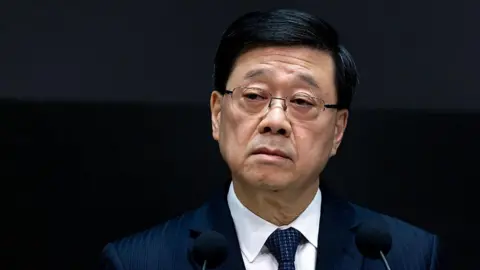
Asked at a news conference earlier this week why he deserves to keep his job following the fire, John Lee sidestepped the question and instead pledged to take to task “anybody who dares to sabotage” relief efforts.
No government official has yet resigned nor been arrested over the fire. The 15 people arrested on suspicion of manslaughter are bosses or staff of construction firms, while another six detained are fire equipment contractors.
Separately, one woman has been arrested for trying to profiteer from the crisis using a fake fundraising campaign.
Some residents have also criticised the decision to proceed with a Legislative Council election, at a time when the city is in mourning. Only pro-Beijing “patriots” are allowed to contest in the poll which will be held on Sunday.
“I think it lacks respect,” Trent Huang, 37, told Reuters news agency. “I really don’t think anything else should be first priority except paying tribute and making sure all the victims and affected people are well taken care of.”



