


Emer Moreau,business reporterand
Jonathan Josephs,business correspondent

 Department for Business and Trade
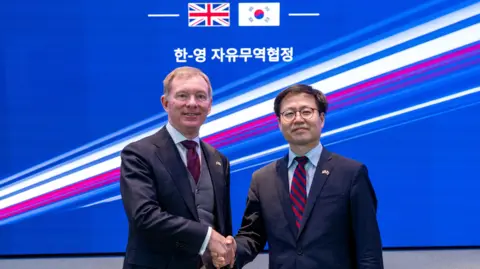
The UK and South Korea have finalised a trade deal which the government says will create thousands of jobs and bring billions into the British economy.
British industries including pharmaceuticals, car manufacturing, alcohol and financial services are expected to benefit from an extension to the current tariff-free trade on most goods and services.
The deal is the fourth such agreement struck by the Labour government, following deals with the EU, US and India — none of which have had a material impact on the UK’s economy so far.
South Korean culture, including music, cosmetics and food, has become much more popular in the UK in recent years.
Trade minister Chris Bryant announced the deal in Samsung’s flagship store in London on Monday night, accompanied by his Korean counterpart Yeo Han-koo.
Under the deal, 98% of trade will continue to be tariff free, the same terms that the EU has with South Korea, and which the UK maintained temporarily after Brexit.
The UK’s agreement with South Korea was set to expire in January 2026, but the new agreement will protect £2bn of UK exports from an increase in tariffs.
Prime Minister Keir Starmer said the deal was “a huge win for British business”.
“This deal making trade even easier between us will help boost the economy – supporting jobs and growth which will be felt all over the country,” he said.
Bryant said the deal would give “cast-iron protections to our key industries to speed up economic growth as part of our Plan for Change”.
South Korea is the UK’s 25th largest trading partner, according to the Department for Business and Trade. In the 12 months to the end of June this year, it accounted for 0.8% of the UK’s total trade.
Over that same 12-month period, official figures show UK exports to South Korea fell 16.4% and South Korean exports to the UK fell 10.8%.
South Korea’s trade minister told the BBC that South Korea and Britain’s economies “are complimentary”, and denied that the fall in trade between the nations suggested the relationship wasn’t as important as it used to be.
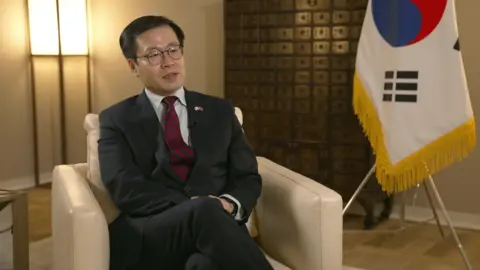
Han-koo said the new agreement was more about reducing non-tariff barriers, such as making rules around product origin more business friendly, and creating new digital and investment protections.
“So these two economies can win by cooperating closer through this kind of framework,” he added.
Han-koo also said Britain can serve as a gateway for South Korea in its trade with Europe, while South Korea can serve as a gateway to Asia for British companies.
The South Korean deal is the latest in a series of post-Brexit trade agreements, but the independent budget forecaster, the OBR, has so far deemed deals done with those larger partners as unlikely to make a measurable impact on the UK economy by 2030.
The government has said that its various trade agreements struck this year will grow the British economy by creating jobs and cutting red tape for small businesses.
But its own assessment showed that the deal with India will only increase GDP by between 0.11% and 0.14%.
That deal in particular was criticised for potentially undercutting British workers.
India is the UK’s 10th-largest trading partner, accounting for 2.5% of British trade.
‘Great news’
UK companies including Bentley Motors, Jaguar Land Rover (JLR) and Guinness owner Diageo welcomed the news of the South Korean deal.
Frank-Steffen Walliser, chairman and chief executive of Bentley Motors, said that South Korea is a key market for the company and the wider luxury vehicle market.
“To secure immediate ongoing access to South Korea and a positive long term trade deal, is great news. Smooth international trade is vital to UK automotive business growth.”
Diageo’s interim chief executive Nik Jhangiani said it would “help satisfy the growing demand from South Korean consumers” for Guinness, which is canned in Runcorn, Cheshire.
Emily Weaver Roads, interim international director at the Scotch Whisky Association, said the Asia-Pacific region was the largest regional market by value for whisky.
“The reduction of trade barriers in the Republic of Korea will further enhance Scotch Whisky’s access to an important market, especially for single malts.”



