



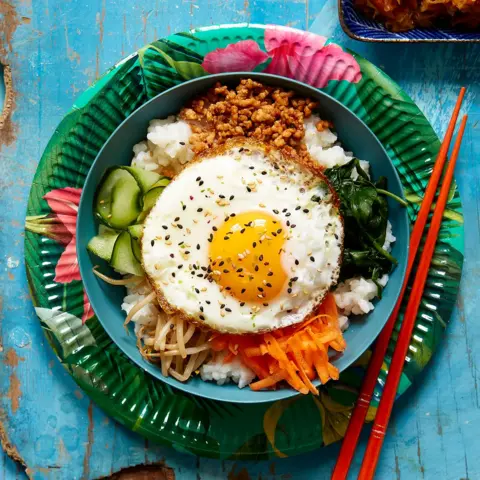
 Future Publishing via Getty Images
Standing around a kitchen island with a small group of other food writers, I pull on a pair of plastic gloves and begin massaging a bright red paste into wedges of cabbage.
We are in Korean-American TV chef Judy Joo’s London flat, learning how to make kimchi from scratch.
Kimchi – sharp, funky, fermented cabbage – has become a kind of shorthand for Korean food in the UK. Judy calls it “the cornerstone of Korean cuisine”.
“Traditionally, Koreans eat kimchi 365 days a year,” Judy tells me. Kimchi recipes are passed down “like heirlooms”, she adds.
The group joke about the chilli under our nails and the smell lingering on the train home, but we’re all excited to have a jar of homemade kimchi ready to put in the fridge.
Judy, who’s known for bringing Korean food to British audiences, was leading a class tied to Ocado’s new Korean food aisle. It’s part of what appears to be a growing trend of bringing Korean food further into the British mainstream.
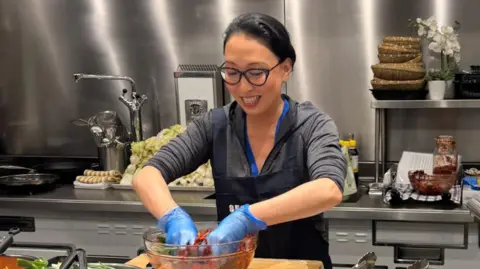 Judy Joo
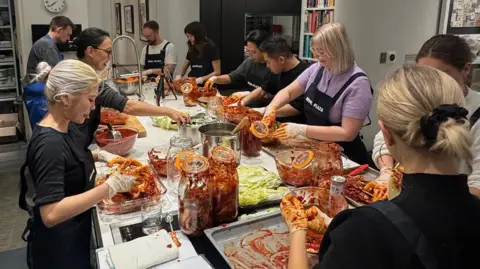 Judy Joo
Growing up as a Korean in London, I was used to my culture turning up at school in the form of food. On “international day”, my mum would be asked to send in Korean dishes for pupils to try. Teachers were often more curious than students, and there was usually confusion about whether it was another type of Chinese food.
Korean food has never been in competition with other Asian cuisines – it simply wants to be seen and tasted on its own terms. As more Korean restaurants have opened, and as I’ve gone back to Korea and explored its food there, I’ve watched that shift happen in both places.
‘Fermented foods, such as kimchi, have become mainstream’
Back in 2009, the South Korean government launched a “Global Hansik” campaign to raise the profile of Korean food abroad, putting public money into restaurant promotion, chef training and overseas marketing. The programme drew criticism at the time for lacking clear results but, later, government studies suggested awareness of Korean food in major overseas cities rose over the first half of the 2010s.
Since then, Korean food has increasingly travelled alongside the broader “K-wave” of pop culture. Food-centred drama Bon Appétit, Your Majesty has showcased Korean fusion dishes, while South Korean competition show Culinary Class Wars returns for a second season on Netflix this month after topping the platform’s global non-English TV chart in its first run.
The shift is also visible on UK shelves. Searches for “Korean BBQ” on Waitrose’s website are up more than 60% year on year, and sales of its gochujang paste have risen more than 70%. Kimchi is among its fastest-growing international products.
“Fermented foods, such as kimchi, have become mainstream,” explains nutritionist Emer Lowry. “They enhance flavour and texture, but also offer benefits including improved digestion and a diverse, healthier gut microbiome.”
And the interest in Korean food didn’t just happen overnight – it’s driven by curiosity. Analysis by Bibigo, part of food giant CJ, suggests TikTok posts by UK users mentioning Korean food have risen from just under 10,000 in 2023 to more than 17,000 in 2025.
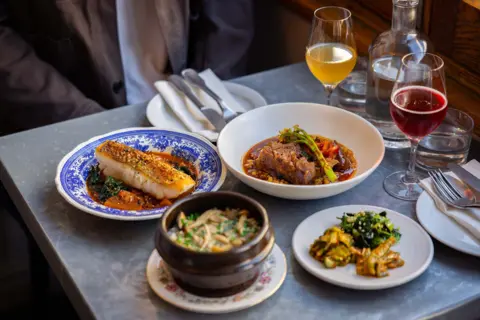 Lola Lee
At Cálong, a restaurant in North London, chef Joo Won is exploring what it means to cook Korean food in Britain. In his early career in a London hotel kitchen, he worked with chefs from France, Italy, Spain, Greece and Thailand. Between shifts, they would take it in turns to cook meals from home for each other and, one day, the others asked him to make something Korean.
“When they asked me to cook Korean food, I realised I couldn’t,” he says. “As a Korean person and a chef, being unable to cook Korean food was embarrassing.”
He began revisiting the dishes he grew up with, not just restaurant staples but the home cooking most non-Koreans never encounter. “In Korea, the real foundation of our food is jang,” he says, referring to fermented pastes and sauces such as doenjang, ganjang and gochujang.
But ingredients in Britain are different. “We can’t get exactly the same ingredients here that we have in Korea,” he says. “So a big challenge is: how do we reinterpret the character of British ingredients in a Korean way?
“We’re a restaurant that uses Korean techniques and flavours, but we also rely heavily on what’s available here in the UK,” he continues. “If an ingredient doesn’t suit Korean seasoning, there’s no need to put gochujang on it. If every dish at an Italian pasta restaurant came out with the same sauce, it would feel strange.”
As the popularity of Korean food grows, Joo thinks chefs may find it easier to source the authentic products they need. “At the moment, I’d say we’re only at the beginning. It feels like we’ve just reached the starting line.”
Food is the most important part of Korean dining culture. But Yoonsun Chang – who runs a Korean supper club – says Jeong, a deep warmth and care often associated with Korean hospitality, and inyeon, a sense of meaningful connections formed at the table, are also key. “What I try to give is jeong, but what’s created through these gatherings is also inyeon.”
LoKoLi – short for “Lovely Korean Life” – is a one-woman project run by Yoonsun, who creates one-off dining experiences built around Korean food and culture. I first came across her on Instagram and was struck by how much of it she was doing alone, driven by her own desire to show a version of Korean life that reflected what she loved.
Guests at her monthly clubs, which she usually hosts at home, often say they want more than the obvious elements of K-culture. They already know the music and dramas. What they’re seeking is the quieter, domestic side of Korean life: the table setting, the stories behind everyday dishes.
She also pays close attention to how Korean food appears outside Korean spaces. She recalls a time when “kimchi burgers” in Britain used “just some generic pickles”. Now, she says, pubs and restaurants increasingly use real kimchi. “Seeing that makes me feel Korean culture has really spread,” she says.
‘The flavour profiles were so different to what we were used to’
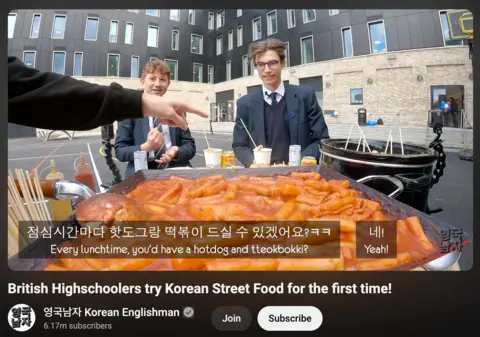
For British YouTubers Armand and Max, their introduction to Korean food came after taking part in a viral video for the Korean Englishman YouTube channel. Now in their early 20s, they say that day changed the way they eat.
The video, which featured the pair trying Korean street food in their school playground, was seen by tens of millions – and eventually took them to Korea itself, where they tried barbecue, late-night ramyun and school lunches.
“The flavour profiles… were just so different to what we were used to,” says Max. “Fermented cabbage, kimchi, we’d never had that. That was delicious. I can’t even compare it to anything.”
 Korean Englishman
Back in Judy’s kitchen, as cabbages disappear into jars, she explains that proper kimchi needs weeks to ferment, though we were encouraged to taste it as it developed – as people do when making it at home.
The jar I made that day is now bubbling away in my fridge. It’s not the kind of kimchi my family would have made, but the process – rubbing paste into each leaf, waiting for the tang to deepen – connects back to kitchens thousands of miles away.
Korean food in Britain is still young compared with other cuisines. It has not replaced anyone’s Friday-night takeaway. But from supper clubs and YouTube channels to supermarket aisles and small flats where people are learning to make kimchi for the first time, it is steadily becoming part of everyday life.



